Feb 6, 2026
Why You Shouldn't Use AI Logos for Branding

Why You Shouldn’t Use AI Logos for Branding
And why the cheapest shortcut often becomes the most expensive mistake.
There’s no denying it that AI has changed the creative industry fast.
In a matter of seconds, you can generate a logo, a color palette, a slogan, and even an entire “brand identity” without ever speaking to a designer.
For startups and small businesses trying to save money, that sounds incredibly tempting.
But here’s the problem:
Most AI-generated logos don’t build brands. They just create graphics.
And there’s a huge difference between the two.
A real brand isn’t just something that “looks nice.” It’s recognition. Trust. Memory. Personality. Emotion. The best logos become symbols people instantly associate with quality, experience, and reputation.
AI can imitate design styles.
It cannot understand brand meaning.
“The moment your brand looks like everyone else’s, customers stop remembering you.”
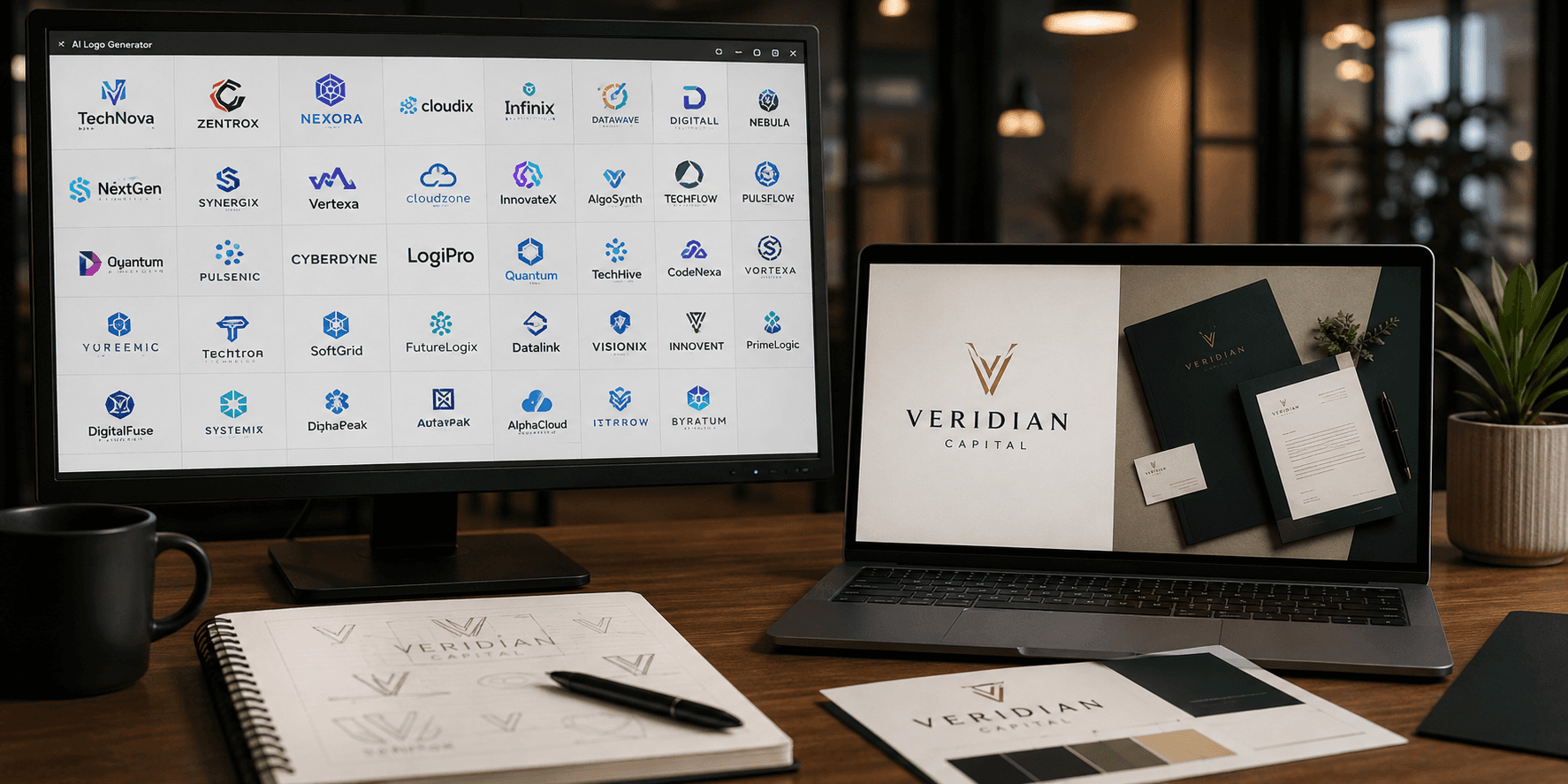
AI Logos All Start to Look the Same
Spend ten minutes browsing AI logo generators and patterns start appearing immediately:
Generic minimalist icons
Overused geometric shapes
Predictable typography
Trend-chasing gradients
Symbols with no real connection to the business
The issue isn’t that AI logos are always ugly.
The issue is that they’re forgettable.
AI systems are trained on existing design trends and datasets. That means they naturally reproduce what already exists rather than creating something strategically original.
As a result, thousands of businesses end up with logos that feel strangely familiar.
And in branding, familiar is dangerous.
If your audience confuses your company with five others in your industry, your logo isn’t helping your business grow.

Branding Is Strategy, Not Decoration
A professional designer doesn’t just ask:
“What looks good?”
They ask:
Who is your audience?
What emotions should your brand create?
What makes your company different?
How should people feel when they see your identity?
Where will the logo appear?
Will it still work in five years?
That process matters.
Because effective branding is built around positioning, psychology, storytelling, and long-term recognition.
AI tools skip almost all of that.
They generate outputs based on prompts — not business understanding.
That’s why many AI-generated logos look polished at first glance but completely fail when applied in the real world.
They don’t scale properly.
They don’t reproduce consistently.
They don’t communicate a unique identity.
And often, they don’t even make strategic sense for the industry they represent.
Your Brand Shouldn’t Look Cheap
Consumers notice branding more than business owners realize.
A weak logo immediately creates subtle assumptions:
The company may be inexperienced
The product may be low quality
The business may not be established
The service may not be trustworthy
Fair or not, visual identity shapes perception instantly.
If your branding looks rushed, generic, or template-driven, people subconsciously treat your business the same way.
That’s especially dangerous for businesses operating in competitive industries where trust matters — agencies, consulting firms, luxury brands, tech companies, real estate, law, healthcare, and e-commerce.
Strong branding creates confidence before a customer ever reads a single word.

Legal Problems Are Becoming a Real Issue
Another overlooked problem with AI logos is ownership.
Many AI generators are trained on massive datasets pulled from existing artwork and designs. That creates a gray area around originality and copyright.
Some AI-generated logos may unintentionally resemble existing trademarks or copyrighted work.
Imagine investing in:
a website,
packaging,
merchandise,
social media branding,
…only to discover your logo cannot legally be trademarked.
That risk becomes much larger as more businesses rely on the same AI tools generating similar outputs.
A custom-designed logo gives you something far more valuable:
Distinctiveness.
AI Is a Tool — Not a Brand Designer
This doesn’t mean AI is useless in branding.
Far from it.
AI can be incredibly helpful for:
brainstorming ideas,
exploring visual directions,
generating moodboards,
testing concepts,
accelerating workflows.
Many professional designers already use AI internally as part of their process.
But there’s a difference between using AI as a creative assistant and letting it define your entire identity.
The strongest brands still require human thinking:
taste, intuition, cultural understanding, emotional intelligence, and strategy.
Those things cannot be automated.
At least not convincingly.
The Long-Term Cost Is Higher Than the Short-Term Savings
Most businesses choose AI logos because they’re cheap.
But branding is one of the few investments customers interact with constantly.
A weak identity can quietly cost you:
credibility,
conversions,
referrals,
recognition,
and customer trust.
Eventually, many companies end up rebranding anyway — paying twice for a problem they tried to solve cheaply the first time.
Good branding is expensive because it has value.
And memorable brands are rarely built from shortcuts.
Final Thoughts
AI will absolutely continue transforming design.
But branding is deeply human.
The best logos aren’t generated from prompts. They’re built from understanding — understanding people, culture, psychology, emotion, and business positioning.
A logo should tell a story before your company ever speaks.
And the brands people remember most are usually the ones that feel intentional, distinctive, and real.
Not generated.
Recent News
Inside knowledge from our experts